
Football Guides
How Football League Tables Work
A football league table ranks teams by points: 3 for a win, 1 for a draw and 0 for a defeat. When teams are level on points, each league applies its own tiebreakers, such as goal difference or head-to-head results.
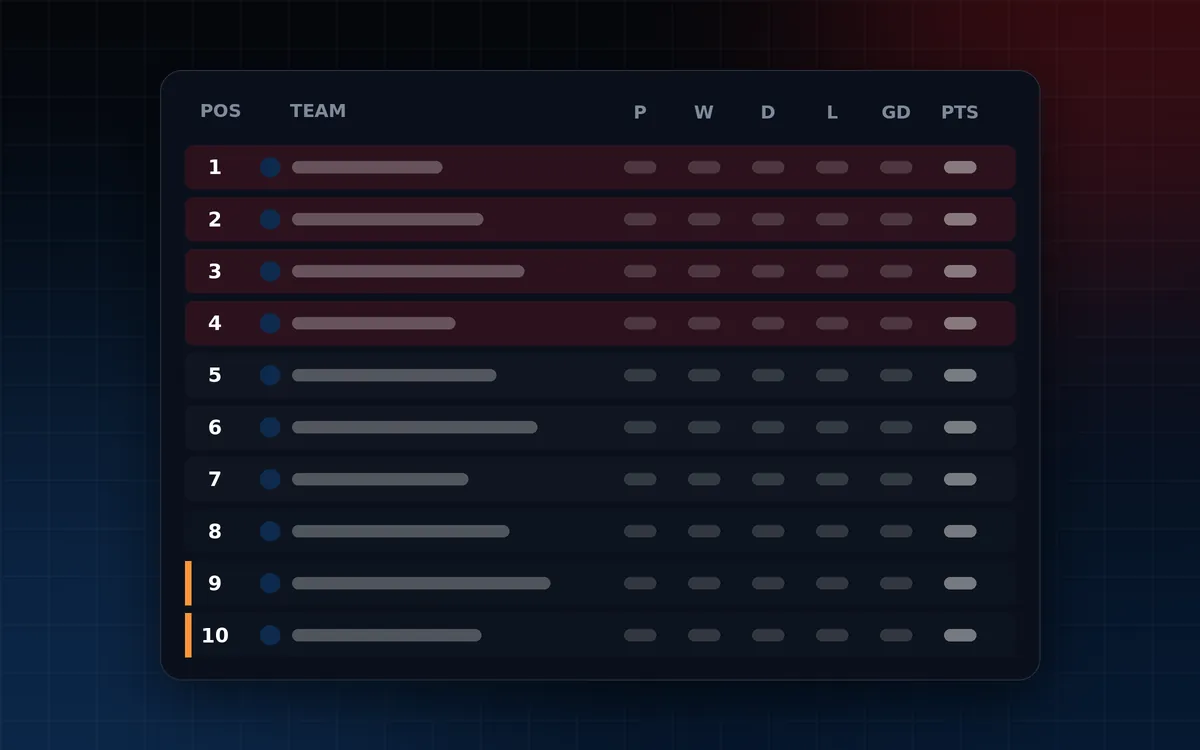
Reading the columns
| Column | Meaning |
|---|---|
| Pos | Position in the table |
| P (or MP) | Matches played |
| W / D / L | Wins, draws and losses |
| GF / GA | Goals for (scored) and goals against (conceded) |
| GD | Goal difference: goals for minus goals against |
| Pts | Points |
| Form | Results of the most recent matches, newest usually on the right or left depending on the source |
The points system
Almost every league uses 3 points for a win, 1 for a draw and 0 for a defeat. England's Football League adopted three points for a win in 1981, and it spread worldwide during the 1990s. The aim was to reward attacking play: winning one match and losing another (3 points) is now worth more than drawing twice (2 points).
A worked example
The table below uses fictional teams to show how points and goal difference are calculated.
| Pos | Team | P | W | D | L | GF | GA | GD | Pts |
|---|---|---|---|---|---|---|---|---|---|
| 1 | Team A | 10 | 7 | 2 | 1 | 20 | 8 | +12 | 23 |
| 2 | Team B | 10 | 7 | 2 | 1 | 18 | 9 | +9 | 23 |
| 3 | Team C | 10 | 6 | 3 | 1 | 15 | 7 | +8 | 21 |
| 4 | Team D | 10 | 5 | 1 | 4 | 12 | 12 | 0 | 16 |
Team A's points: 7 wins × 3 = 21, plus 2 draws × 1 = 23. Teams A and B are level on 23, so the league's tiebreaker decides who ranks higher.
Tiebreakers by league
| League | First tiebreaker after points |
|---|---|
| Premier League | Goal difference, then goals scored |
| Bundesliga | Goal difference, then goals scored |
| La Liga | Head-to-head record between the tied teams |
| Serie A | Head-to-head record between the tied teams (with special rules for some positions) |
Table zones
Tables are often shaded to show what positions lead to: the title, qualification for continental competitions, promotion play-offs or relegation. The number of places in each zone depends on the league and, for continental places, on how that country's clubs have performed in recent seasons.
Reading a table in context
- Games played: teams with games in hand may be in a stronger position than their rank suggests.
- Points per game helps compare teams with different numbers of matches played.
- Early-season tables are volatile; small differences mean little until more matches are played.