
Team Form
How to Read Team Form
Team form is a team's recent run of results, usually its last five or six matches, shown as W (win), D (draw) and L (loss). It is a useful snapshot, but it becomes much more informative when you consider opponents, venues and the performances behind the results.
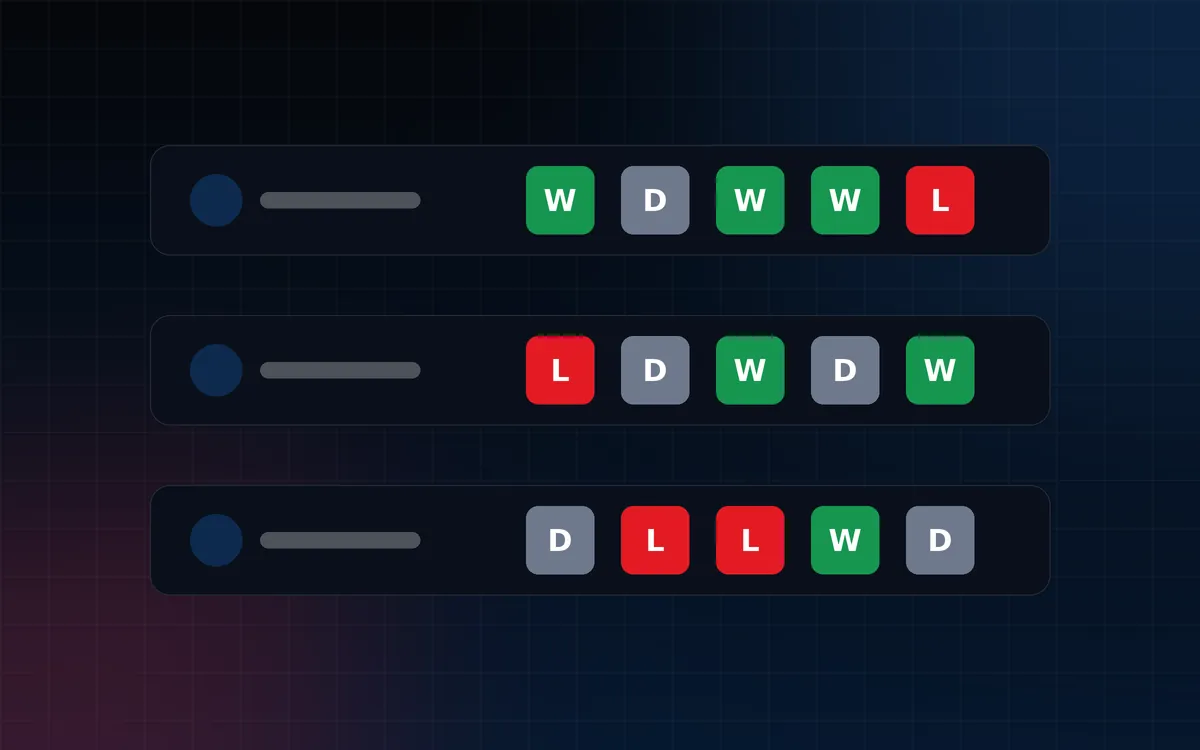
Reading a form guide
A form guide lists recent results in order. For example, means win, draw, win, win, loss. Sources differ on whether the newest result is on the left or right, so check the label. This example uses fictional results.
Points from form are easy to calculate: 3 per win and 1 per draw. The sequence above earns 3 + 1 + 3 + 3 + 0 = 10 points from a possible 15.
Home and away form
Many teams perform differently at home and away. Splitting form by venue gives a clearer picture of an upcoming fixture. Read about home advantage
Points per game
Points per game (PPG) divides points by matches played. It lets you compare teams that have played different numbers of games, and compare a recent run with a whole season.
Strength of schedule
Three wins against teams near the bottom of the table are not the same as three wins against the top sides. Look at who a team has played, and who comes next on the fixture list.
Results vs. performances
A team can win while creating few chances, or lose while creating many. Underlying numbers such as expected goals for and against help show whether a run of results is likely to continue or is partly the product of fortune. See how xG works
The limits of form
- Five or six matches is a small sample.
- Injuries, suspensions, managerial changes and fixture congestion can change a team quickly.
- Form describes the past. It is never a guarantee of the next result.